Shift-Left with Git Branch-Aware Testing

The traditional QA bottleneck is a well-known pain point for modern development teams. For years, the industry has pushed to "shift-left" – to move testing earlier in the development lifecycle. However, a major technical hurdle has always remained: the environment gap.
When QA happens on a global "staging" environment or only after code merges to the main branch, the feedback loop is too slow. Bugs found post-merge cause expensive context-switching for developers and delay releases.
Today, we’re bridging that gap. We’ve added full branch awareness to the TestChimp platform, enabling true shift-left testing at the PR level.

Why Branch-Aware Testing?
Branch-aware testing means your QA process mirrors your Git workflow. Instead of testing "the app," you test the "feature-in-progress."
1. Test Authoring at the Feature Level
You can now switch between repository feature branches directly within TestChimp. File versions are maintained per branch, allowing QAs to sync with branch-specific remote content.
Most importantly, QAs can author tests and raise Pull Requests from TestChimp that merge directly into the feature branch. This ensures that by the time a developer is ready to merge their code, the corresponding tests are already part of the PR.
[!TIP] Security & Outsourcing: Our new GitHub App-based approach means you don't need to give external QA resources full repository access. They can work exclusively on the
testsandplansfolders (with PRs raised via TestChimp platform), maintaining a tight security posture.
2. Branch-Specific Test Execution
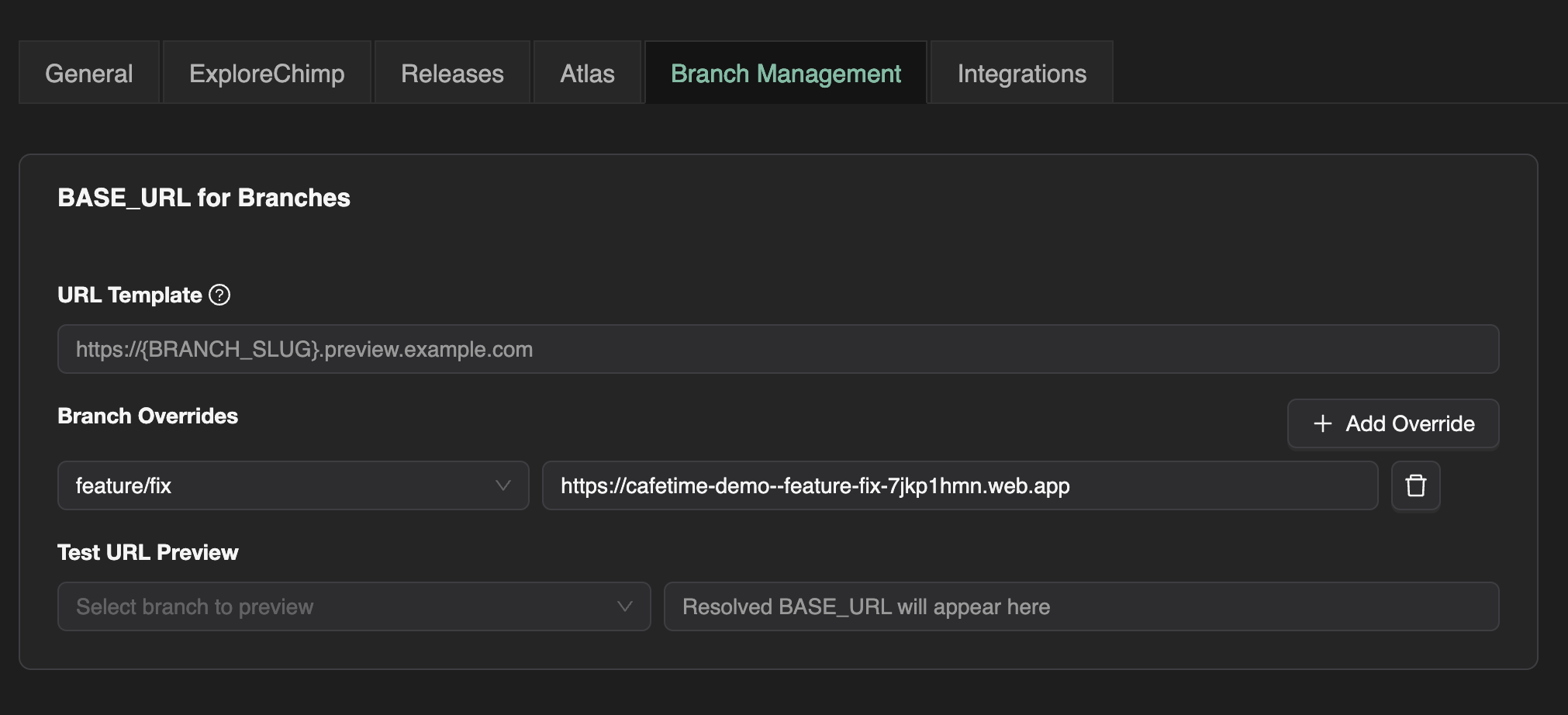
Gone are the days of manually pointing tests at different URLs. In your project settings, you can now configure a template string for branch-specific deployment URLs (e.g., Vercel or Netlify preview URLs).
When you run tests on a branch, TestChimp resolves the correct URL and injects it as a BASE_URL environment variable. Your scripts simply consume process.env.BASE_URL, ensuring they always target the correct preview deployment.
3. Exploratory Testing & Smart Bug Diffing
Exploratory testing is no longer a "post-release" activity. All exploratory runs can now be executed against the branch-specific deployment.
Our agents are now smart enough to report only new bugs found on the feature branch compared to the default branch. This allows you to instantly see what UX, performance, accessibility, or internationalization issues were introduced by a specific PR – before they ever touch production.
4. QA Intelligence: Sliced by Branch
In the Atlas page, you can now filter results by branch to see exactly how a specific screen or flow was affected by a PR. This level of granularity allows teams to answer the questions that actually matter during code review:
- "What user stories are breaking in this PR?"
- "Are unrelated scenarios being affected by these changes?"
Seamless CI Integration
If you already have a CI pipeline that generates preview URLs, TestChimp fits right in. Simply pass that preview URL as the BASE_URL environment variable in your CI action, and your tests will execute against the live branch deployment with zero extra configuration.
Strategic Planning, Tactical Execution
While test authoring and execution are now branch-aware, we’ve intentionally kept Test Planning artifacts product-scoped.
Strategy should be stable. Planning artifacts continue to sync with the repo's default branch, ensuring your high-level test coverage goals remain consistent even as individual features are developed and tested in parallel branches.
The Future is Shift-Left
By moving QA participation closer to the development phase, you’re not just catching bugs – you’re preventing them from ever reaching the main branch. Branch-aware testing turns QA from a gatekeeper into a core part of the feature development engine.