Why Test Plans in Code if Jira can expose an MCP?

Why Store Test Plans in Code if Jira can expose an MCP?
If Jira can expose an MCP to fetch a list of stories, and another call to fetch or update each story — is there an advantage in maintaining them in code instead (what we enable with TestChimp)?
This question comes up often when teams try to retrofit agents into existing workflows. And there are legitimate reasons for doing that — switching costs are real. But if you’re in a greenfield-ish project, the upside of a code-first approach can be significant.
The difference is akin to comparing someone who has read the entire library to someone who has a library card.
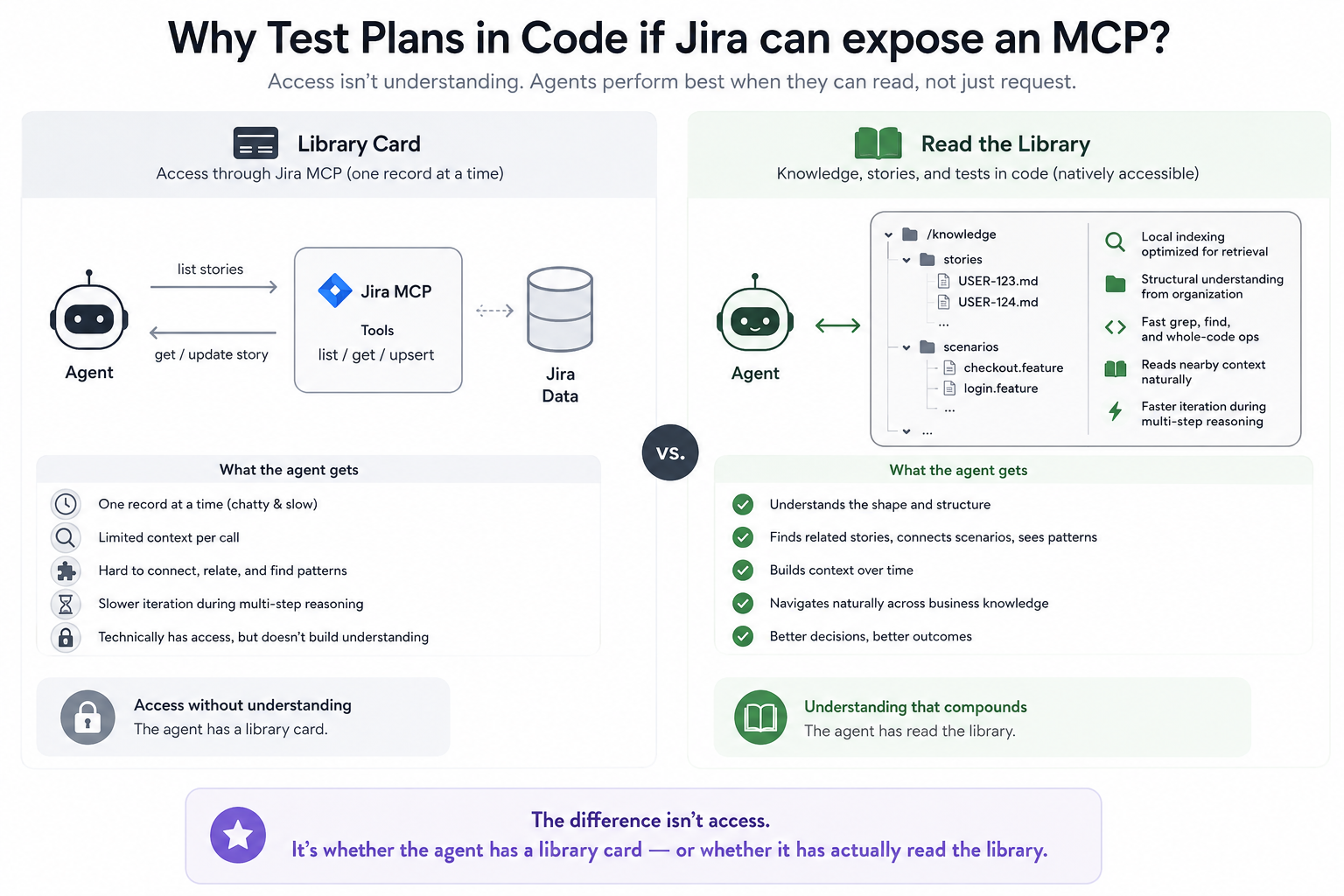
Technically, the person with the library card also has access to everything. But access and understanding are not the same thing.
Apply the same idea to your codebase. Theoritically, you could store your code in some remote SaaS as individual files and expose three MCP tools:
list_filesread_fileupsert_file
Your agent would technically have “full access” to the codebase.
But that would be massively inefficient. Having the code available as colocated local files gives agents advantages that cannot be replicated through API calls:
- Local indexing optimized for agentic retrieval
- Structural understanding through folder organization
- Faster whole-code operations like
grepandfind - Reading surrounding context naturally
- Faster iteration during multi-step reasoning (Chain of thought)
The agent doesn’t just access the code - it starts to understand the shape of it.
Now imagine extending those same advantages beyond code. What if your knowledge base, user stories, and test scenarios lived in a form the agent could access natively?
Now your agent has business context about your product (similar to how it has code context). Not through a tool called one record at a time, but as something it can index, understand in aggregate, capture structural relationships from, and navigate naturally. It can find related stories. Connect scenarios. Understand patterns. Build context over time.
The difference isn’t access.
It’s whether the agent has a library card - or whether it has actually read the library.