Introduction
In brief: TrueCoverage overlays the same user-event taxonomy from production and test runs so teams see which real pathways lack SmartTest coverage and close gaps by business impact.
Scope: TrueCoverage applies to web (browser), iOS, and Android when the client is instrumented with the platform RUM SDK and tests run with @testchimp/playwright and the correct TESTCHIMP_PROJECT_TYPE. See Instrumenting your app for the authoritative self-service guide (npm / SwiftPM / JitPack, init, emits, automation hooks). Native test authoring uses Mobile testing.
TrueCoverage connects real user behaviour with your test efforts so you can see exactly which user pathways are covered by tests and which are not. Unlike typical product analytics tools, TestChimp tracks the same event emits during test runs as in production. That alignment lets you tie test insights directly to the behaviours real users exhibit—and surface coverage gaps in a way that drives prioritization.
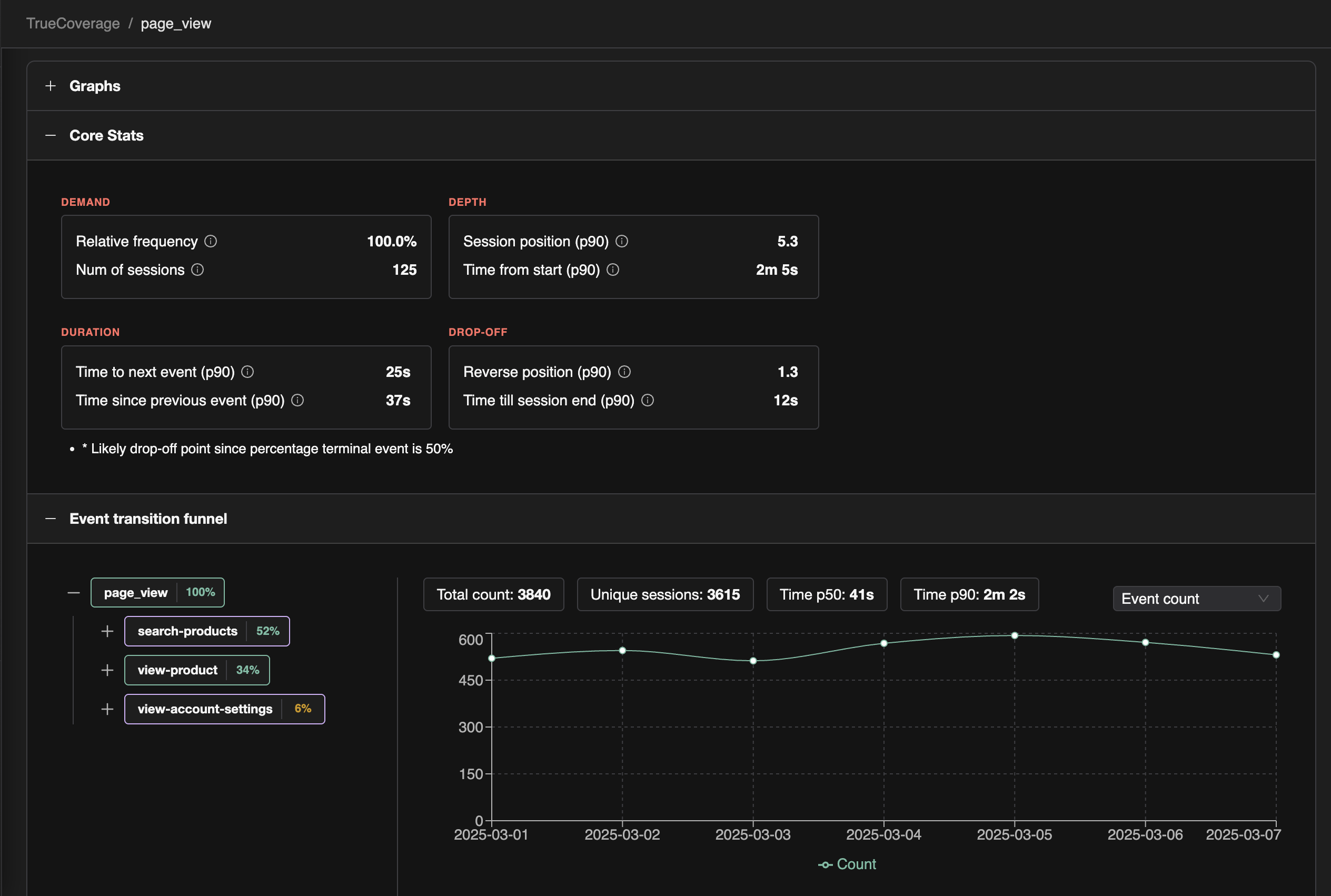
What TrueCoverage Unlocks: The 4Ds of RUM-based QA Strategy
TrueCoverage organizes event-level insights into four categories that guide how you prioritize testing:
- Demand — Which actions users perform most often. Covering these in tests protects core user journeys from regressions. We track relative frequency, number of occurrences, and unique sessions per event.
- Duration — Where users spend the most time. Prioritize deeper testing here, including variations and alternative paths. We track time to next event, time since previous event, time from session start, and time to end of session.
- Drop-off — Where users abandon sessions. Check test coverage to rule out bugs and investigate potential usability issues. We track percentage of sessions where the event is terminal, reverse index in session, and time from event to end of session.
- Depth — How deep into a session users typically reach a given feature. Ensure top-of-funnel events are well tested, since they gate the rest of the user journeys. We track position in session, reverse index, and time to first occurrence in session.
By aligning production event data with test execution data, TrueCoverage highlights where real user behaviour is not covered by tests, so you can close high-impact gaps first (e.g. "users are dropping off here—and there is no test covering that path").
How It Differs From Typical Product Analytics
Typical product analytics software focuses on understanding user behaviour in production only. TestChimp goes further:
- Same events in test runs: Events are emitted in both production (via @testchimp/rum-js on web, testchimp-rum-ios / testchimp-rum-android on native) and during test execution. @testchimp/playwright augments those emits with test identification (page injection on web; automation URLs on iOS/Android when configured), so TestChimp can align test runs with the same event taxonomy used in production.
- Test coverage over real behaviour: You can define a “base” scope (e.g. production or a specific environment) for event funnels and frequencies, and a “coverage” scope (e.g. test runs). TrueCoverage then overlays which events and pathways are covered by tests, so you see coverage relative to what users actually do.
- Prioritization by frequency: Use relative event frequencies and metadata breakdowns to prioritize testing—e.g. “this event variant is very common in production but has no test coverage.”
Together, this lets you identify high-priority test gaps (e.g. “users are dropping off here—and there is no test covering that path”) and connect exploratory findings (e.g. usability or performance bugs) to the same steps where users struggle.
Prioritizing Testing Efforts
You can use TrueCoverage to prioritize testing by the 4Ds (Demand, Duration, Drop-off, Depth) and by metadata:
- Demand: Focus test design on the most frequent events (relative frequency, unique sessions).
- Duration: Prioritize steps where users dwell (time to next event, time since previous).
- Drop-off: Ensure events where users often abandon have test coverage.
- Depth: Ensure top-of-funnel and high-depth events are well tested.
- Metadata key values: Drill down into metadata (e.g.
form_of_payment,checkout_step) to see which variations of an event are common and which are covered—so you can add tests for high-frequency variants that lack coverage.
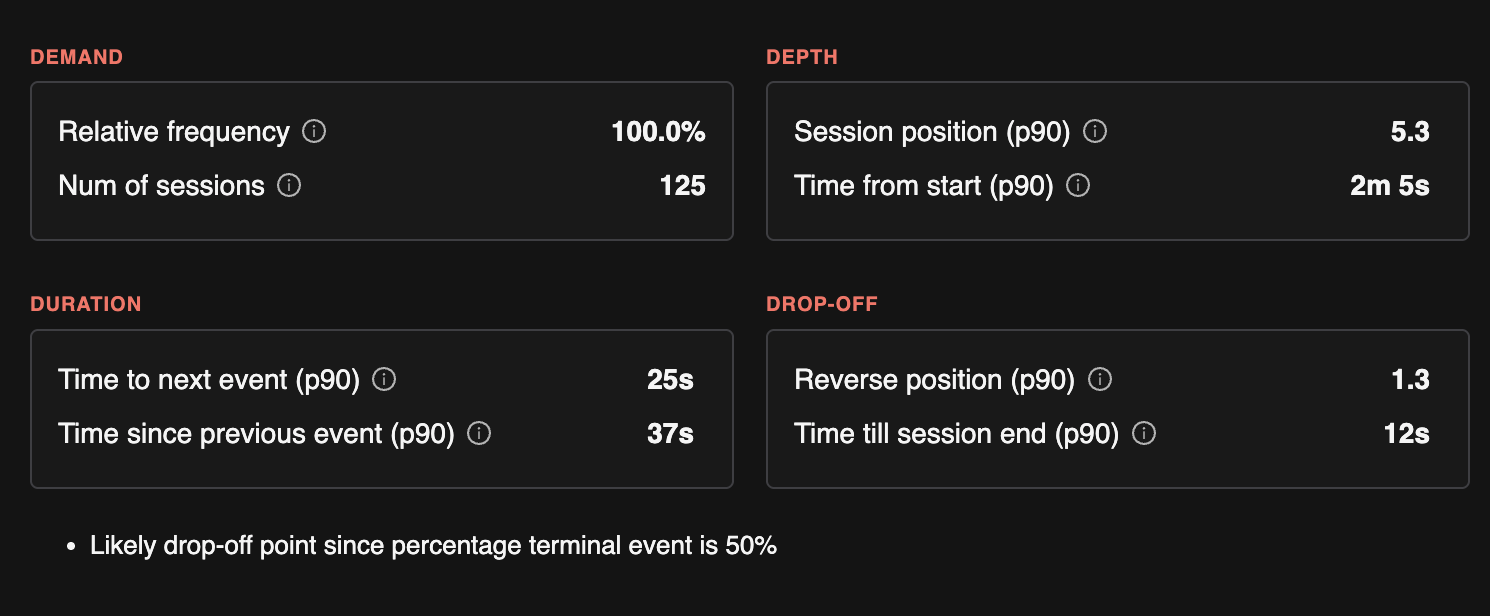
These inputs help you address “users are dropping off here” and “there is no test covering that path” in a data-driven way, and to align exploratory agent findings (e.g. bugs at a given step) with real user behaviour.
Next Steps
- Instrumenting your app — Web, iOS, and Android SDKs and Playwright wiring (self-service).
- How it works — Events, sessions, metrics, and event transitions.
- Dashboard — Overview, event detail, funnel, sample sessions, and metadata slicing.
FAQ
How is TrueCoverage different from code coverage?
It measures behavioural pathway coverage—what users actually do—not lines of code executed in unit tests.
Which platforms support TrueCoverage?
Web via @testchimp/rum-js, iOS and Android via native RUM SDKs, plus @testchimp/playwright for test identity.
What are the 4Ds?
Demand, Duration, Drop-off, and Depth—metrics that prioritize which events and funnels need SmartTests first.
How does evolve use TrueCoverage?
/testchimp evolve ingests gap signals to expand SmartTests and fixtures on high-impact uncovered paths.