Requirement Traceability, Without the Spreadsheet Circus

Q: How do you currently get requirement traceability?
Which user stories and scenarios are covered by tests, and what’s failing?
A:
For most teams, it looks something like this:
User stories live in Jira.
Test cases live somewhere else.
The mapping between them lives in an Excel sheet that someone manually maintains.
That spreadsheet is periodically uploaded to a test management tool like PractiTest. Then test execution results are pushed via an API to get a view of coverage and failures.
It works—until it doesn’t.
The problem with today’s approach
This is how requirement traceability is typically achieved today: a hodgepodge of tools stitched together with process and hope.
- Multiple sources of truth
- Manually maintained spreadsheets that inevitably go stale
- Fragile workflows that break as teams and test suites scale
No single system actually owns the full picture. Instead, teams spend time keeping artifacts in sync rather than improving product quality.
A simpler model with TestChimp
In TestChimp, requirement traceability isn’t an afterthought. It’s built in.
You already author detailed user stories and break them down into meaningful test scenarios directly in the platform - with AI assistance that understands your product through your existing test scripts and documentation.
Linking tests to those scenarios is intentionally simple. In your test script, add a comment:
scenario annotations <scenario title>
That’s it! TestChimp takes care of the rest:
- Automatically links tests to scenarios
- Tracks execution results across runs
- Aggregates outcomes at scenario, story, and suite level
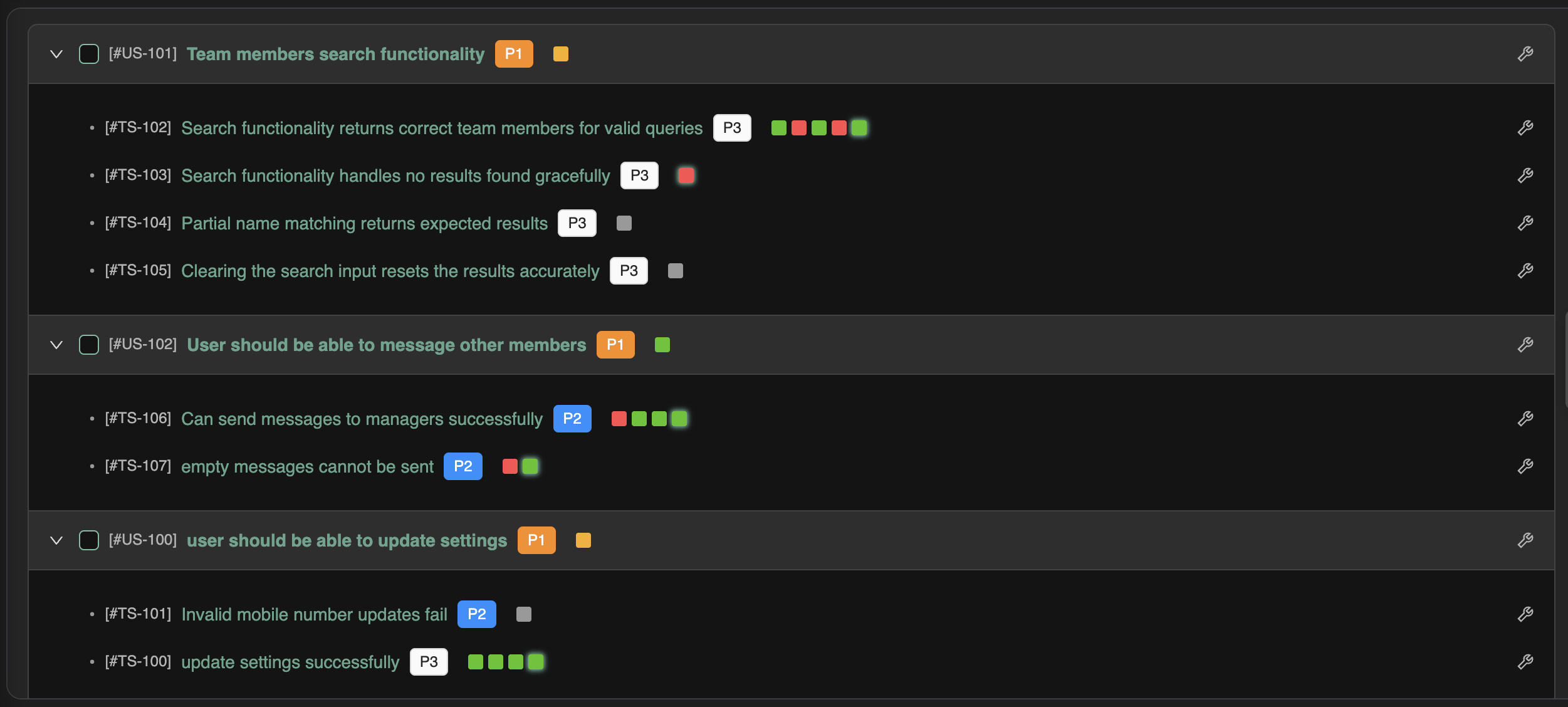
You get clear, real-time dashboards that let you answer business relevant questions:
- Which user stories are missing test coverage?
- Which scenarios are currently failing?
- Which tests are flaky or unstable?
All without juggling multiple tools or maintaining brittle Excel sheets.
⸻
One system, end to end
Instead of retrofitting traceability after the fact, TestChimp treats it as a first-class concept - connecting requirements, scenarios, and executions in one place.
- No spreadsheets.
- No manual syncing.
- Just a single system that understands what you’re building, how it’s tested, and where the gaps are.